
SNU’s LRFC Strengthens Global Competence with UK Visit to Universities and Lloyd’s Register
작성자
admlrfc
작성일
2025-08-24
조회
69
The Lloyd’s Register Foundation Research Centre for Future Ship Safety (LRFC) at Seoul National University carried out a meaningful visit to the United Kingdom from August 18 to 23, 2025, as part of its Global Exchange Program (GEP). The program was designed to strengthen students’ global capabilities and broaden their international perspectives through diverse academic and cultural activities.
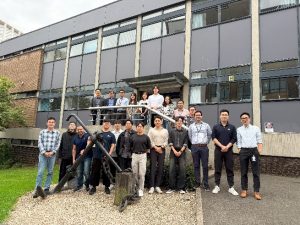
Led by Professors Yong-Hwan Kim and Bo-Woo Nam, a delegation of 10 students visited the University of Strathclyde and the University of Southampton, where they presented their research, toured advanced experimental facilities, and engaged in vibrant academic exchanges with local researchers. The group also visited the Lloyd’s Register Heritage Center in London, gaining insights into the rich history of the British shipbuilding and maritime industries and experiencing historical collections firsthand.
LRFC’s GEP initiative has been actively supporting students in building international competencies through various opportunities. This summer, five students also successfully completed internships at leading UK institutions under the same program.
An LRFC representative shared, “This visit provided our students with a valuable opportunity to expand their understanding of global naval architecture and marine engineering while nurturing the skills needed to thrive on the international stage. We remain committed to growing these programs to foster world-class talent in the maritime field.”

The Global Exchange Program (GEP) I joined in the summer of 2025 was a precious opportunity to broaden my academic horizons and take another step forward as a researcher. Despite the short schedule, I was able to visit various institutions and universities, directly experiencing both the traditions and the current research trends that the UK has cultivated in the field of naval architecture and ocean engineering.
Our first visit to the Kelvin Hydrodynamics Laboratory left a deep impression on me. Although its towing tank is smaller than the one at Seoul National University, countless experiments are carried out there, resulting in many internationally recognized papers. I was struck by the realization that meaningful research outcomes can be achieved when creative ideas and systematic methodologies come together, even with small-scale facilities. This inspired me to dedicate myself with even greater passion to my own research.
During the mini-workshop at the University of Strathclyde, I was able to explore various studies centered on computer-based simulations. Watching how numerical analysis techniques are used to solve complex fluid problems allowed me to vividly understand how the theories and skills I am learning now are applied in practice. Through the research presentations of local students, I also discovered that UK academia places great importance on safety issues. This reminded me once again that marine research is not only about efficiency or economics but is directly tied to public safety.
In Southampton, our first stop was the Lloyd’s Register Global Technology Center, where I learned about the critical role this world-leading classification society plays. I was impressed to discover that Lloyd’s Register is not merely a certification body, but also a key player in developing and verifying new technologies while ensuring safety and reliability across the entire maritime industry. At the University of Southampton, another mini-workshop introduced us to the latest developments in environmentally friendly and sustainable marine technologies, such as wind-powered propulsion systems. Observing a high-speed vessel towing experiment in the university’s towing tank was particularly meaningful, as I was able to witness firsthand the generation of wave patterns that I had only studied in theory.
Finally, visiting the Lloyd’s Register Foundation in London helped me understand why Lloyd’s Register continues to hold such strong global influence, despite the UK no longer having large shipyards. The answer lay in its historical foundation and accumulation of knowledge. The vast collection housed in the Old Library included books and records dating back to the 1700s and 1800s. I realized that these resources form the identity of Lloyd’s Register and continue to underpin its authority and trust to this day. More than relics of the past, they remain valuable sources of knowledge for today’s researchers and the maritime industry, which left a profound impression on me.
Through the GEP program, I was able to directly confirm both the tradition and history of British naval architecture and ocean engineering, as well as the current research topics considered most important. Preparing and delivering a presentation in English also helped me recognize my shortcomings while giving me a real sense of growth. Despite the linguistic challenges, the experience of expressing my ideas and engaging in academic exchange will, I believe, serve as a great asset for continuing my research on the international stage.
Above all, the experience I gained from this program has influenced not only my academic knowledge but also my research attitude and overall outlook on life. I came to realize that what matters most in research is not the size of the equipment or the conditions of the environment, but the passion and thorough approach to solving problems. This is a mindset I intend to carry with me throughout my research career.
Finally, I would like to express my sincere gratitude to the Lloyd’s Register Foundation for providing this invaluable opportunity and to my professors for their thoughtful guidance and support. Building on what I have learned from this GEP program, I am committed to working harder to become a researcher who contributes not only to academic achievement but also to international collaboration.
Led by Professors Yong-Hwan Kim and Bo-Woo Nam, a delegation of 10 students visited the University of Strathclyde and the University of Southampton, where they presented their research, toured advanced experimental facilities, and engaged in vibrant academic exchanges with local researchers. The group also visited the Lloyd’s Register Heritage Center in London, gaining insights into the rich history of the British shipbuilding and maritime industries and experiencing historical collections firsthand.
LRFC’s GEP initiative has been actively supporting students in building international competencies through various opportunities. This summer, five students also successfully completed internships at leading UK institutions under the same program.
An LRFC representative shared, “This visit provided our students with a valuable opportunity to expand their understanding of global naval architecture and marine engineering while nurturing the skills needed to thrive on the international stage. We remain committed to growing these programs to foster world-class talent in the maritime field.”
Student Reflection: Growing as a Global Researcher through the GEP Program
For Jung-Hyun Kim, a master’s student at Seoul National University, the Global Exchange Program (GEP) held in the UK this summer was more than just an academic trip—it was a turning point in his journey as a researcher. Below is the full text of his reflection as a participant in the Global Exchange Program (GEP):The Global Exchange Program (GEP) I joined in the summer of 2025 was a precious opportunity to broaden my academic horizons and take another step forward as a researcher. Despite the short schedule, I was able to visit various institutions and universities, directly experiencing both the traditions and the current research trends that the UK has cultivated in the field of naval architecture and ocean engineering.
Our first visit to the Kelvin Hydrodynamics Laboratory left a deep impression on me. Although its towing tank is smaller than the one at Seoul National University, countless experiments are carried out there, resulting in many internationally recognized papers. I was struck by the realization that meaningful research outcomes can be achieved when creative ideas and systematic methodologies come together, even with small-scale facilities. This inspired me to dedicate myself with even greater passion to my own research.
During the mini-workshop at the University of Strathclyde, I was able to explore various studies centered on computer-based simulations. Watching how numerical analysis techniques are used to solve complex fluid problems allowed me to vividly understand how the theories and skills I am learning now are applied in practice. Through the research presentations of local students, I also discovered that UK academia places great importance on safety issues. This reminded me once again that marine research is not only about efficiency or economics but is directly tied to public safety.
In Southampton, our first stop was the Lloyd’s Register Global Technology Center, where I learned about the critical role this world-leading classification society plays. I was impressed to discover that Lloyd’s Register is not merely a certification body, but also a key player in developing and verifying new technologies while ensuring safety and reliability across the entire maritime industry. At the University of Southampton, another mini-workshop introduced us to the latest developments in environmentally friendly and sustainable marine technologies, such as wind-powered propulsion systems. Observing a high-speed vessel towing experiment in the university’s towing tank was particularly meaningful, as I was able to witness firsthand the generation of wave patterns that I had only studied in theory.
Finally, visiting the Lloyd’s Register Foundation in London helped me understand why Lloyd’s Register continues to hold such strong global influence, despite the UK no longer having large shipyards. The answer lay in its historical foundation and accumulation of knowledge. The vast collection housed in the Old Library included books and records dating back to the 1700s and 1800s. I realized that these resources form the identity of Lloyd’s Register and continue to underpin its authority and trust to this day. More than relics of the past, they remain valuable sources of knowledge for today’s researchers and the maritime industry, which left a profound impression on me.
Through the GEP program, I was able to directly confirm both the tradition and history of British naval architecture and ocean engineering, as well as the current research topics considered most important. Preparing and delivering a presentation in English also helped me recognize my shortcomings while giving me a real sense of growth. Despite the linguistic challenges, the experience of expressing my ideas and engaging in academic exchange will, I believe, serve as a great asset for continuing my research on the international stage.
Above all, the experience I gained from this program has influenced not only my academic knowledge but also my research attitude and overall outlook on life. I came to realize that what matters most in research is not the size of the equipment or the conditions of the environment, but the passion and thorough approach to solving problems. This is a mindset I intend to carry with me throughout my research career.
Finally, I would like to express my sincere gratitude to the Lloyd’s Register Foundation for providing this invaluable opportunity and to my professors for their thoughtful guidance and support. Building on what I have learned from this GEP program, I am committed to working harder to become a researcher who contributes not only to academic achievement but also to international collaboration.